
What is Lightweight Deflectometer (LWD) Testing?
Lightweight Deflectometer (LWD) testing is a fast, non-destructive method for assessing the stiffness and load-bearing performance of soils and unbound materials. The test provides an immediate measurement of surface modulus, helping engineers and contractors verify ground conditions before construction progresses.LWD testing is particularly effective for evaluating subgrades, sub-bases, and working platforms, offering a practical alternative to more time-consuming laboratory-based strength tests. It is widely used across highways, infrastructure, and commercial development projects where rapid decision-making is essential.
Reliable and Efficient Lightweight Deflectometer Testing from GSTL
At GSTL, we provide professional Lightweight Deflectometer testing carried out by experienced technicians using calibrated, industry-approved equipment. Our mobile testing capability allows us to attend sites quickly and deliver results on the same day, helping to keep projects on programme.
LWD testing can be used as a standalone assessment or alongside other in-situ testing methods to provide a more comprehensive picture of ground performance.
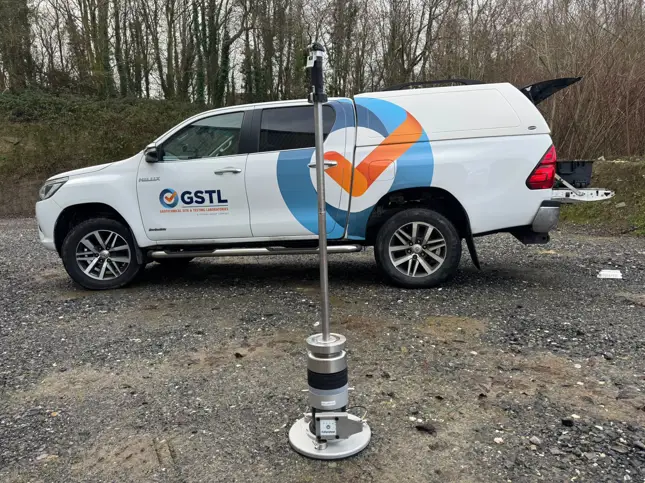
How Does a Lightweight Deflectometer Test Work?
The LWD test involves placing a circular loading plate directly onto the ground surface. A known weight is then dropped from a controlled height onto the plate, generating a short impulse load. Sensors within the device measure the resulting surface deflection.
From this data, the dynamic surface modulus is calculated, providing a clear indication of material stiffness and uniformity. Each test takes only a few minutes to complete, enabling efficient assessment of multiple locations across a site.
Results are available immediately, allowing engineers to:
- Confirm whether the ground meets design specifications.
- Identify weak or inconsistent areas.
- Decide quickly on any required remediation or improvement.

What Projects Require Lightweight Deflectometer (LWD) Testing?
Roads, Pavements, and Car Parks
LWD testing is commonly used during road, pavement, and car park construction to assess the performance of subgrades and granular layers. It helps ensure that materials are compacted correctly and can support traffic loads.
Engineers use LWD results to:
- Verify compaction quality
- Demonstrate compliance with design requirements
- Reduce the risk of premature pavement failure
Working Platforms
For sites requiring safe access for heavy plant and machinery, LWD testing provides rapid verification of the performance of the working platform. The test supports compliance with industry guidance and helps ensure that platforms are suitable for the loads they will carry.
Earthworks and General Groundworks
During earthworks, LWD testing enables frequent and repeatable checks across large areas. This allows contractors to maintain consistent quality and address any issues before construction progresses to later stages.
Why Choose GSTL for Lightweight Deflectometer Testing?
- Expert Technicians – All tests are conducted by trained professionals with extensive site experience.
- Rapid Results – Immediate on-site data supports quick decision-making and reduces delays.
- Flexible Site Coverage – Mobile testing enables efficient assessment of multiple locations.
- Complementary Testing – LWD testing can be combined with other in-situ tests for a robust ground assessment approach.
Our LWD Testing service aligns closely with our broader ground investigation and testing offering, including in-situ strength California Bearing Ratio and working platform evaluations.
FAQs about Lightweight Deflectometer (LWD) Testing
What does a Lightweight Deflectometer (LWD) measure?
A Lightweight Deflectometer measures the stiffness and load-bearing performance of soils and unbound materials by recording surface deflection under a dynamic load. The results are used to calculate a surface modulus value, which indicates how well the ground can support construction loads.
What is the difference between LWD testing and a CBR test?
LWD testing provides an immediate, non-destructive assessment of ground stiffness, making it ideal for rapid site checks and quality control. A California Bearing Ratio (CBR) test, by comparison, measures soil resistance to penetration and is typically used for pavement design. LWD testing is often used alongside or as a quicker alternative where real-time results are required.
Is Lightweight Deflectometer testing suitable for working platforms?
Yes. LWD testing is widely used to assess working platforms for heavy plant and machinery. It allows engineers to verify platform performance quickly and identify weak areas that may require improvement before use.
How long does an LWD test take?
Each LWD test typically takes only a few minutes to complete. This allows multiple test locations to be assessed quickly, making it particularly effective for large sites or projects with tight programmes.
Are LWD test results available on site?
Yes. One of the key advantages of LWD testing is that results are available immediately. This enables engineers and contractors to make informed decisions without waiting for laboratory analysis.
What types of projects benefit from LWD testing?
LWD testing is suitable for a wide range of projects, including:
- Roads, pavements, and highways
- Car parks and hardstandings
- Working platforms
- Earthworks and general groundworks
Can LWD testing replace laboratory soil testing?
LWD testing does not replace laboratory testing entirely but provides a fast and effective in-situ assessment. It is commonly used for verification, quality control, and comparative testing across a site, alongside laboratory tests where required by specification.
Who carries out the testing?
All Lightweight Deflectometer testing is carried out by trained technicians from GSTL using calibrated equipment to ensure accurate and reliable results.